Select a site alphabetically from the choices shown in the box below. Alternatively, browse sculptural examples using the Forward/Back buttons.
Chapters for this volume, along with copies of original in-text images, are available here.


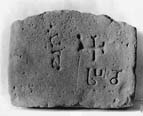
Object type: Part of slab [1]
Measurements: L. 53 cm (20.9 in) W. 40 cm (15.7 in) D. 8.9 cm (3.5 in)
Stone type: Medium-grained feldspathic deltaic sandstone with sub-angular grains. Brown (10YR 5/3). Rock chisel-dressed, inscribed top smoothed but not dressed (i.e. irregular). Stone provenance as Whitby 1 (abbey, St Peter and St Hilda)
Plate numbers in printed volume: Ills. 1067–9
Corpus volume reference: Vol 6 p. 261-262
(There may be more views or larger images available for this item. Click on the thumbnail image to view.)
A (broad) : The surface is uneven but smoothly finished. To one side there is a deeply incised, slightly asymmetrical cross with forked terminals (type B2), flanked by two groups of lettering at right angles to each other.
Inscription An incised inscription is informally disposed in two sections along two adjacent sides of an incised cross. Both the letters and the cross are deeply cut into the roughly dressed surface of the slab. The letters vary greatly in height (from 2.8 to 7.5 cm). If it is assumed that the two sections of letters were arranged with their tops pointing towards the cross, the inscription may be read as follows:
Okasha (1971, 124) also suggested an alternative reading that assumes that the letters of the first section were arranged with their feet towards the cross:
[C]IN
BVRG
In either case the text would be a feminine personal name, either the recorded Cynburg or the possible, but unrecorded, *Wīdburg (Okasha 1971, 124, 153; Boehler 1930, 46–8, 136–8; Searle 1897, 485–6).
The incised cross seems to have been intended as a Latin rather than an equal-armed cross. If so, the first section of the inscription and the first element of the name were placed at the foot of the cross. In that case, it would be more natural to assume that the inscription and the cross were the same way up and therefore that the first element was VI[D].
The letter forms seem to have been drawn from Insular half-uncial. If we assume that the heads of all the letters pointed towards the cross, the first letter is a rounded V, although the distinction of a rounded first stroke and a straight second stroke of the half-uncial (or uncial) letter cannot be seen here. Alternatively, if viewed the other way up, this might be a minuscule N with somewhat splayed rather than parallel sides. The third letter was either an uncial D or, if viewed the other up, a C. If it was a C, the lower part of the letter extends a long way to the right. If it was a D, one would expect the loop to be more closed than it now is. The first letter in the second element of the inscription is half-uncial (or perhaps, given the straight rather than sinuous first stroke, minuscule) B. The V and the uncial R probably derive from Insular half-uncial. As on Whitby 24 and 47 the bowl of the R is left wide open at the base. The final G is the half-uncial letter with the lower stroke stylized into a vertical and a closed loop.
B and D (short) : Roughly dressed.
C (long) : Broken.
E (long) : Now covered with a layer of mastic so that the slab can be set upright on this edge.
F (base) : Roughly dressed.
It is probable from its measurements that this piece can be identified with no. 26 in the original excavation report, although no mention is made there of an inscription (Peers and Radford 1943, 40). Radford thought that this slab was part of the mensa of an altar, but both the short sides seem to be original. The cross and the lettering are cut to a similar depth, and appear to be contemporary (see Butler's suggestion cited below).
Inscription This monument can probably best be interpreted as an unambitious funerary memorial with the name of the deceased carved near an incised cross. The idea may have been suggested by the more sophisticated 'name-stones' produced in centres such as Lindisfarne and Hartlepool, on which names were inscribed around a more elaborate and carefully executed cross. Butler (1973, 222) makes the interesting suggestion that the inscription was cut onto an altar by a pilgrim, and cites as parallels graffiti cut onto an altar at Vouneuil-sous-Biard and onto a cross-slab at Ballavarkish, Bride, Isle of Man. These, however, to judge from reproductions are lightly incised and quite unlike the boldness of the lettering of Whitby 49 (Kermode 1911, 69–74; Cabrol and Leclercq 1925, s.v. 'Graffites' at cols. 1523–4, figs. 5381–2).
If Whitby 49 can be accepted as a funerary monument, the use of an informal inscription on a roughly prepared slab may be a sign of disruption during the later years of the monastery (Higgitt 1995, 235). The irregular lettering, which is freely derived from Insular half-uncial, also suggests a later, probably ninth-century date.
