Select a site alphabetically from the choices shown in the box below. Alternatively, browse sculptural examples using the Forward/Back buttons.
Chapters for this volume, along with copies of original in-text images, are available here.


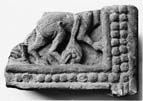
Object type: Slab fragment [1]
Measurements: H. 20.5 cm (8 in) W. 32 cm (12.6 in) D. 11 cm (4.3 in)
Stone type: Medium-grained micaceous sandstone with sub-rounded grains; a well sorted fabric but with 10mm hollow lignite nodule. The bedding is parallel to the mica grains and to the crude cross face. Very pale brown (10YR 7/4). Stone provenance as Whitby 20 (abbey, St Peter and St Hilda)
Plate numbers in printed volume: Ills. 1070–4
Corpus volume reference: Vol 6 p. 262
(There may be more views or larger images available for this item. Click on the thumbnail image to view.)
A (broad) : A cable moulding runs along the surviving edge. Next to this moulding on the inner edge are two rows of aligned pellet fillers. The slab has been divided into two panels by a plain moulded frame, between which a single row of pellet fillers runs. The upper panel contains a well-modelled quadruped carved in deep relief with rounded haunches. The top of the panel is broken at the neck of the beast. Three limbs remain complete, the fourth is raised up beside the animal's neck next to the border and is broken. The other front limb rests above the bottom of the panel against the border, and the back limbs are flexed in a walking position with one behind the other. Each foot has four toes with claws and the middle foot rests against a large seed pod. To the left of the beast is the stump of a tree-scroll. The stem of the seed pod appears to come from this tree, trailing across the beast's back and falling down its flank to rest on the bottom of the panel. Very little of the lower panel survives apart from the border.
B (narrow) : Plain.
C (broad) : The remains of a slot or moulding runs along the one surviving edge to the left. Within this frame part of a cross of type D9 is incised in low relief with a grooved edge moulding. One lateral arm and part of the neck survive.
D (narrow) and E (top) : Broken.
F (bottom) : The edge is rebated, plausibly to adjoin another panel.
The carving on both faces of this slab could be explained as it having been reused at a later date. The inscribed cross of face C would then have been the original decoration, and forms part of the Whitby Plain Cross series (Chapter VI). In that case the monument originally took the form of a small recumbent slab (Peers and Radford 1943, 34). It is possible, however, that it always formed part of a composite monument. Peers and Radford suggest, on the basis of its small size, that the slab formed part of a shrine to contain a body (ibid.). In which case the possibility exists that the cross was part of the original conception and was meant to be on the interior, as found for example on the Cuthbert coffin (Bailey 1989, 238–43, fig. 14). If that were so, the stem of the cross could have been extended, and the stump of tree-scroll behind the animal would have formed a central division to the panel.
The naturalistic carving of the beast, with muscles and tendons indicated, and the fluid carving of the tree-scroll, point to a very accomplished carver and a date at the height of the achievement of Anglian carving. The pellet fillers are reminiscent of those used by the Uredale master (Chapter VI), though the arrangement of beast and tree-scroll indicate that this is not his work, and may originate in Carolingian ivories.
