Select a site alphabetically from the choices shown in the box below. Alternatively, browse sculptural examples using the Forward/Back buttons.
Chapters for this volume, along with copies of original in-text images, are available here.


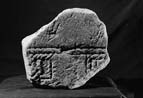
Object type: Architectural fragment or part of shrine [1]
Measurements: H. 23 cm (9 in) W. 27 cm (10.6 in) D. 13.5 cm (5.3 in)
Stone type: Coarse ferruginous sandstone with sub-rounded to sub-angular grains. Light yellowish brown (10YR 6/4). Stone provenance probably as Whitby 1 (abbey, St Peter and St Hilda)
Plate numbers in printed volume: Ills. 1075–8
Corpus volume reference: Vol 6 p. 263
(There may be more views or larger images available for this item. Click on the thumbnail image to view.)
Only one corner of this piece survives, with two incomplete carved faces.
A: The broad face is divided by a cable moulding, with the area above plain. The lower section is decorated with two small panels on either side with a broader plain panel in the centre, perhaps the remains of a cross; the smaller panels are surrounded by cable mouldings. The right side and lower edge are broken.
B and C: Broken away.
D: The cable moulding frames part of a smoothly finished plain face which lies at an obtuse angle to face A, and slopes away above. On the right is a small panel surrounded by cable moulding similar to those on face A.
E: The sloping upper surface is roughly dressed but may be original.
Because of the fragmentary nature of this piece it is not possible to be sure whether it is part of a block impost or, as suggested by Derek Craig (pers. comm.), part of a small shrine tomb. Comparable block imposts with panelled ornament have been found on the monastic site at Jarrow (Cramp 1984, pl. 106, 578–80 and pl. 107, 581), but these lack the chamfered face. If this is a shrine fragment of the 'sarcophagus' type, in the shape of a low building (Cramp 1991, xxi, fig. 4f), then it might be compared with the larger monument at Bedale (no. 6; Ills. 23–5). Similar decoration is found on Stonegrave 6 (Lang 1991, ills. 845–60). The restrained ornament of this piece is typical of the Whitby school, and it is important evidence for the fitments of the pre-Conquest stone church at Whitby.
