Select a site alphabetically from the choices shown in the box below. Alternatively, browse sculptural examples using the Forward/Back buttons.
Chapters for this volume, along with copies of original in-text images, are available here.


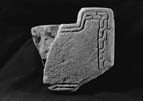
Object type: Fragment, possibly architectural or furnishing, in two joining pieces [1]
Measurements:
a: L. 21 cm (8.2 in) W. 26 > 21 (10.2 > 8.2 in) D. 6.5 > 5 cm (2.6 > 2 in)
projection W. 10 cm (4 in) D. 5 cm (2 in)
b: L. 29.5 cm (11.6 in) W. 23 cm (9 in) D. 11 > 6.5 cm (4.3 > 2.6 in)
projection W. 10.8 cm (4.2 in) D. 5.5 cm (2.1 in)
As reconstructed: L. 29.5 cm (11.6 in) W. 25.5 cm (10 in) D. 15 > 13.3 cm (5.9 > 5.2 in)
Stone type: Both fragments are of fine-grained feldspathic, micaceous sandstone with a sub-angular grain fragment. The stone has been axe-dressed and then partially smoothed. The natural stone colour of both fragments is a yellow colour (10YR 7/6), but fragment b has been surface-burnt to a reddish brown colour (2.5YR 4/4). Stone provenance probably as Whitby 1 (abbey, St Peter and St Hilda)
Plate numbers in printed volume: Fig. 20; Ills. 1079–83
Corpus volume reference: Vol 6 p. 263-264
(There may be more views or larger images available for this item. Click on the thumbnail image to view.)
This L-shaped (possibly once T-shaped) fragment, with surviving decoration on three faces, is difficult to orientate since its function is obscure. It consists of a rectangular block with a tapering projection on one corner. The opposite corner and the end of the 'shaft' are broken away.
A (broad) : At the broad end of the face step pattern type 2 is enclosed in a double outline. This pattern continues round the corner of the projection and then develops into two strands which outline the plain central 'shaft'.
B (narrow) : Broken at an angle at the top, smooth and plain below.
C (broad) : The face is edged by a double strand, and at the end of the projection the inner strand splits into two opposed coils.
D (narrow) : Plain and smooth on the angled faces.
E (end) : This face is plain but outlined by a double grooved moulding.
Whatever the function of this piece, faces A, C, and E were meant to be seen, and faces B and D could either have been covered or could have been less important. There is no trace of mortar on these plain faces. The straight 'shaft' and the tapering projection are not a recognisable type for a cross-arm. It has been suggested that it is a lintel from a doorway (Lang 1990a, 5; Hawkes 1999b, 410; see Chapter IV), but no reconstruction of such a feature can be envisaged which would show the three decorated faces. It is possible that it is part of some free-standing feature such as a stele, but more plausibly it could have been a bench end or chair arm (see Fig. 20). The simple outlining of the shape is typical of the style of the Whitby plain crosses, and like them the ornament could have been based on wooden prototypes. This is a simpler piece than the highly decorated chair arm from Bamburgh (Cramp 1984, pl. 158, 812–17), or indeed the restrained classical outline decoration of the Hexham frithstool, both in Northumberland (ibid., pls. 186, 1028–9 and 187, 1030–2), but it seems consonant with the other early carving at Whitby and could have been part of the synthronon of the church or the abbatial seat (cf. Monkwearmouth 15a and b: Cramp 1984, pls. 122, 663–7 and 123, 668–71).
