Select a site alphabetically from the choices shown in the box below. Alternatively, browse sculptural examples using the Forward/Back buttons.
Chapters for this volume, along with copies of original in-text images, are available here.


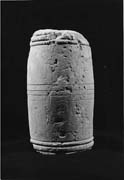
Object type: Part of baluster shaft [1]
Measurements: H. 48.2 cm (19 in) W. 26.5 cm (10.4 in) D. 11.5 cm (4.5 in)
Stone type: Lathe turned in fine-grained, very pale brown (10YR 8/3), micaceous sandstone. The source of this stone is problematical. Although deltaic in origin this stone is unlike any local stone from the Middle Jurassic Saltwick Formation and may be from an Upper Carboniferous source.
Plate numbers in printed volume: Ills. 1084–5
Corpus volume reference: Vol 6 p. 264-265
(There may be more views or larger images available for this item. Click on the thumbnail image to view.)
The baluster is split in half and so it is not possible to be certain whether there was a hole at both ends. There is a heavy double moulding at each end and a shallower pair of mouldings marked by incised lines at the centre. The lowest incised line (the fourth) is very shallow and hardly visible.
Baluster shafts with this drumlike profile and bands of finely incised lines are not common in Northumbria, although they have been found in considerable numbers at Monkwearmouth and Jarrow and in ones or twos at Greatham and Hart, all in co. Durham (Cramp 1984, 24–5). This piece is most closely comparable with the baluster shafts at Monkwearmouth (ibid., 128–9, pls. 120 and 121) which have been dated to the late seventh/early eighth century. An exact parallel for the profile of the Whitby shaft is not however replicated in any other surviving piece.
The presence of this baluster is usually taken to indicate that there was a stone church at Whitby of comparable decoration to those such as Monkwearmouth and Jarrow, but several possible functions can be suggested for this solitary piece: it might have framed an opening, or it could have been part of an altar screen or shrine. It is interesting that the source of the stone is problematic, so this piece could have been manufactured elsewhere.
