Select a site alphabetically from the choices shown in the box below. Alternatively, browse sculptural examples using the Forward/Back buttons.
Chapters for this volume, along with copies of original in-text images, are available here.


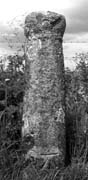
Object type: Cylindrical shaft with capital
Measurements: H. 107 cm (42 in); W. 28 x 31 cm (11 x 12 in). Circumference: at top 82 cm (32 in); collar 73 cm (29in); base 89 cm (35 in)
Stone type: Heavily lichen-encrusted, pinkish grey (5YR 8/1), fine- to medium-grained oolite. The ooliths range from 0.15 to 0.6 mm, but mostly are between 0.3 and 0.4 mm, and are in point contact; a few elongate shell fragments up to 7 mm occur. Portland stone, Portland Freestone Member, Portland Limestone Formation, Portland Group, Upper Jurassic
Plate numbers in printed volume: Pl. 162
Corpus volume reference: Vol 7 p. 128
(There may be more views or larger images available for this item. Click on the thumbnail image to view.)
Monolithic cylindrical shaft crudely tapering, with a rather indistinct collar and capital of cushion form, and traces of moulding at the base. Pope (1906, 15) noted that the north side had been flattened, and that carving on the south side was said to represent a hand. This he could not see, and it is not visible today.
Appendix A item (stones dating from Saxo-Norman overlap period or of uncertain date).
With such a simple monument it is impossible to say whether this is a relocated Roman piece or Anglo-Saxon. The Royal Commission inventory states: 'It is possible that this shaft belongs to the group of preconquest shafts of which the pillar of Eliseg is the best known; if so the capital must have been cut down' (R.C.H.M.(E.) 1952, 17). It is a modest piece compared with the Eliseg pillar, however (Nash-Williams 1950, cat. 182, pl. XXXVI), but it does not seem to be architectural. Perhaps it was conceived as some sort of marker stone, in the native Romano-British tradition, and one is reminded of the monolithic shafts at Wareham, which are usually assigned to the Roman period, and one of which bears a British inscription (pp. 116–17, 119, Ills. 114–17, 122–5, 128–31).
