Select a site alphabetically from the choices shown in the box below. Alternatively, browse sculptural examples using the Forward/Back buttons.
Chapters for this volume, along with copies of original in-text images, are available here.


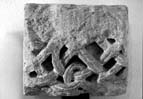
Object type: Fragment of cross-shaft or grave-slab
Measurements: H. 26 cm (10.5 in); W. 23 cm (9 in); D. 17 cm (6.5 in)
Stone type: Yellowish grey (5Y 7/2), poorly sorted, oolitic, matrix-supported, coarsely shelly limestone. Shells, which are mostly bivalve fragments, but with a few bryozoan pieces, are platy and sub-rounded, but a few smaller fragments sub-rounded to well-rounded. Shell fragments, which are roughly aligned, form some 30 to 40 % of rock. Ooliths 0.3 to 0.6 mm diameter weather out to give 'aero-chocolate' texture. Bradford stone, Forest Marble Formation, Great Oolite Group, Middle Jurassic.
Plate numbers in printed volume: Pl. 171
Corpus volume reference: Vol 7 p. 139-40
(There may be more views or larger images available for this item. Click on the thumbnail image to view.)
Only one carved face survives and a portion of that has been destroyed. What is left is part of a pattern of interlace. The strands are deeply and confidently cut with flexible crossings and their tops are median-incised. As currently mounted it is difficult to see all sides, but all the edges are recut although the shorter sides are smoother than the longer.
This fragment is very competent work, but since it is of different stone from the surviving crosshead it is probably not part of the same monument as any of these. Only Bath 2 is, like this, of Bradford stone, and one wonders, with so much good Bath stone around, why this was used.
