Select a site alphabetically from the choices shown in the box below. Alternatively, browse sculptural examples using the Forward/Back buttons.
Chapters for this volume, along with copies of original in-text images, are available here.


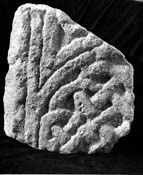
Object type: Fragment of cross-shaft or grave-slab
Measurements: Roman Baths (Earle 1889, 159) H. 30 cm (12 in); W. 26.5 cm (10.5 in); D. 13.5 cm (5 in)
Stone type: Coarsely shelly, matrix-supported oolitic limestone. Ooliths range from 0.3 to 0.6 mm diameter, but mainly between 0.4 and 0.5 mm; weather out to give 'aero-chocolate' texture. Common oyster shells up to 1.5 cm across and with no obvious alignment, form up to 20 % of rock. Bradford stone, Forest Marble Formation, Great Oolite Group, Middle Jurassic
Plate numbers in printed volume: Pl. 172
Corpus volume reference: Vol 7 p. 140
(There may be more views or larger images available for this item. Click on the thumbnail image to view.)
A rough outer moulding encloses a narrow inner moulding, which branches into a curve enclosing interlace of an indeterminate pattern, and the triangular space above is in-filled with a long pointed terminal.
This is rougher workmanship than Bath 1 and the cross-heads, but as noted for Bath 1 it is formed of Bradford stone and could be part of a shaft. Compare Keynsham 12 (Ill. 302).
