Select a site alphabetically from the choices shown in the box below. Alternatively, browse sculptural examples using the Forward/Back buttons.
Chapters for this volume, along with copies of original in-text images, are available here.


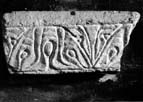
Object type: Architectural fragment
Measurements: H. 18 cm (7 in); W. 36 < 40 cm (14.5 < 15.75 in); D. 7 < 13 cm (2.75 < 5 in)
Stone type: Yellowish grey (5Y 8/1), medium-grained, poorly sorted, matrix-supported, shelly oolite. Ooliths mostly, but not all, weather out to give 'aero-chocolate' texture; they range in size from 0.3 to 1.0 mm, but mostly fall between 0.4 and 0.6 mm. A few bivalve fragments up to 2.5 mm across. Bath stone, Chalfield Oolite Formation, Great Oolite Group, Middle Jurassic
Plate numbers in printed volume: Pl. 354
Corpus volume reference: Vol 7 p. 181-2
(There may be more views or larger images available for this item. Click on the thumbnail image to view.)
A (broad): The only carved face. A band of what seems to be plant ornament is contained within an incised line at the bottom (as displayed) and a broad band marked by an incised line at the top. The ornament is very shallowly carved and indistinct in form, rather as if the carver was copying a design he did not understand. It could be interpreted as paired leaves encircling an eggshaped blob, and pairs of leaf-flowers with long pointed petals on either side of a triangular space filler.
B (narrow): Broken away
C (broad): Recut
D (narrow) and E (top): Smoothly dressed and chamfered Back
Appendix A item (stones dating from Saxo-Norman overlap period or of uncertain date).
The original form of this piece is uncertain: it could have been part of a frieze or cornice, or even (if the smooth upper face were vertical) part of a door jamb. Its date and affiliations are also uncertain. In this region the long pointed leaves and leaf flowers might be considered reminiscent of Keynsham (see Ills. 295, 298, 302), but the prominent boss-like feature is unique in Anglo-Saxon sculpture. It may be an Anglo-Saxon piece copying Roman ornament, or indeed may be of Roman date (pers. comm. David Stocker). In which case it is somewhat reminiscent of the worn cornice from Bath (84) (Blagg 2002, pl. LXXIX), or the more legible ornament on the chamfered cornice block from the legionary baths at Wroxeter (117) (ibid., pl. LXVI).
