Select a site alphabetically from the choices shown in the box below. Alternatively, browse sculptural examples using the Forward/Back buttons.
Chapters for this volume, along with copies of original in-text images, are available here.


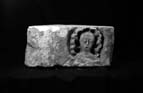
Object type: Block with carved head
Measurements: L. 48 cm (19 in); H. 18.75 cm (7.5 in); D. 31 cm (12.25 in)
Stone type: Yellowish grey (5Y 8/1), medium-grained, poorly sorted, matrix-supported, shelly oolite. The ooliths, which mostly weather out to give 'aero-chocolate' texture, vary from 0.3 to 0.8 mm, but mostly fall in the range 0.4 to 0.6 mm. The scattered bivalve fragments are up to 3 mm across. Bath stone, Chalfield Oolite Formation, Great Oolite Group, Middle Jurassic
Plate numbers in printed volume: Pl. 356
Corpus volume reference: Vol 7 p. 182
(There may be more views or larger images available for this item. Click on the thumbnail image to view.)
The stone is triangular in shape and with two roughly dressed tapering faces, and only the longest face is dressed and carved. The area on the left of this face is plain, but on the right there is a bust, the shoulders of which are on the same plane as the surface of the stone, but the head with surrounding scallops has been deeply inset intaglio fashion within a rounded 'niche'. The depth of carving is about 6 cm. Fourteen scallops surround the head which is cut almost free from the stone. The head, set on a stalk-like neck, is egg-shaped, apparently bald, with prominent bulging eyes, vestigial eyebrows and a small pursed mouth which is slightly open. There is little evidence of drapery folds, but some indentations around the neck may be an embroidered border or a string of beads.
Appendix A item (stones dating from Saxo-Norman overlap period or of uncertain date).
The fact that this piece was found at a location near to the Roman spa and temple complex and within the grounds of the Anglo-Saxon abbey has prompted the question as to whether it is Roman or Anglo-Saxon. There seems no way of knowing what its original form may have been. Stephen Bird, who has considered the piece most exhaustively, says: 'It is likely to have been included in a sizeable structure almost certainly religious in function, into whose walls this and possibly other figures were carved' (Bird 1982, 241). Such a building could include Roman or post-Roman cult centres. The undeniable features of this strange carving are: (a) that the sculptor must have seen shell canopies of classical design, and indeed Bird suggests that such canopies would have been visible to masons on the 'Facade of the four Seasons' nearby from Roman times into the seventh century, when the early Christian nunnery was founded (ibid., 241); (b) the form of the hairless head, and features such as the prominent bulging eyes, straight nose and half-opened mouth are all characteristics of carved stone heads (of both sexes) of the Celtic period and of sub-Roman Britain (Kendrick 1938, pl. IX). Nevertheless, the discovery in a stratified Roman context of a much cruder, but similar bust at Wall, Staffordshire (Henig 2004, xix, 52–3, no. 162, pl. 44), seems to put the Bath piece firmly in the same first- to second-century period. It should be noted however that we have no surviving evidence for figure sculpture in this area before the tenth century, and there seems to have been a sub-culture in the region in which figures such as this, where the head is the prominent element, continued throughout the Anglo-Saxon period (see Yetminster, Dorset, and Blagdon, Somerset: Ills. 153–8 and 357).
