Select a site alphabetically from the choices shown in the box below. Alternatively, browse sculptural examples using the Forward/Back buttons.
Chapters for this volume, along with copies of original in-text images, are available here.


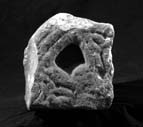
Object type: Part of cross-head [1]
Measurements: H. 20 cm (8 in); W. 19 cm (7.5 in); D. 18 cm (7 in)
Stone type: Pale red (10R 6/2), fine- to coarse-grained (0.2 to 0.6 mm, but mostly medium-grained in the range 0.4 to 0.5 mm), sub-angular to sub-rounded, clast-supported, quartz sandstone. Helsby Sandstone Formation?, Sherwood Sandstone Group, Triassic
Plate numbers in printed volume: Ills. 352-4
Corpus volume reference: Vol 9 p. 134-5
(There may be more views or larger images available for this item. Click on the thumbnail image to view.)
A (broad): The fragment represents the remains of two arms of a circle-headed cross with a boss in the unpierced spandrel. The arms are framed by a moulding and contain fragmentary triquetra. The circle overlaying the arms is defined by an undecorated moulding within framing borders. Any central boss has been chiselled away.
B (narrow): Cut away
C (broad): As face A
D (narrow): The small amount of surviving decoration on the rim of the circle consists of four parallel mouldings within a framing arris moulding; the two outermost of these mouldings are cabled.
Circle-head (see Chapter V, p. 31). The decoration on the broad faces, in its combination of unpierced spandrels with armpit bosses, triquetra ornament and a circle decorated with a simple moulding, can be compared, within the group, to the schemes of West Kirby 2 and Whitford in north Wales (Ills. 349–51; Nash-Williams 1950, no. 190, pl. XXXIV). The multiple, and cabled, mouldings on the rim match those on Bromborough 3, and Chester St John 2 (Ills. 36, 38, 82, 84). In contrast both to those examples and other stones within the circle-head group, however, this head is extremely thick.
