Select a site alphabetically from the choices shown in the box below. Alternatively, browse sculptural examples using the Forward/Back buttons.
Chapters for this volume, along with copies of original in-text images, are available here.


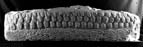
Object type: Hogback [1]
Measurements: L. 178 cm (70 in); W. (at ends) 21.5 > 23 cm (8.5 > 9 in); H. 35 < 47 > 33 cm (13.75 < 18.5 > 13 in)
Stone type: Light olive-grey (5Y 6/1), non-calcareous, fine- to medium-grained (0.2 to 0.3 mm), well-graded, thinly bedded (in units 1 mm to 7 cm thick), quartz sandstone. ?Cefn Stone, Upper Coal Measures, Carboniferous (Boswell, in Collingwood 1928, 21, footnote)[2]
Plate numbers in printed volume: Ills. 355-8
Corpus volume reference: Vol 9 p. 135-6
(There may be more views or larger images available for this item. Click on the thumbnail image to view.)
Hogback, type h; a small fragment of the plain ridge has survived. Walls and roof are almost vertical, except at the very top of the stone above the tegulae.
A (long): Below the ridge is a run of 'wheel and bar' ornament consisting of lightly incised circles linked by a horizontal bar; this tapers to reflect the curve of the top of the stone. Below are three rows of type 10 tegulation. The lower row overhangs the wall decoration which consists of lightly incised three-strand plait; the strands are median–incised and the lay-out is highly irregular.
B and D (ends): Plain
C (long): Only a small section of ornament (possibly plait) survives near the ridge of the stone on this face. Immediately below is tegulation, well-ordered into three rows of type 10 to the left, but more badly laid out to the right where the individual tegulae more closely resemble type 2c (Cramp 1991, fig. 7). The wall decoration below represents a tighter version of the three-strand plait seen on face A.
Hogback (see Chapter V, p. 38). Recent discussion has emphasised the high-status nature of the hogback form of monument (Stocker 2000, 198–9; Bailey and Whalley 2006). The rarity of this type in the region indicates that monuments like West Kirby 4 must have represented an even more striking statement of social standing than they do in Yorkshire or Cumbria, where they are found in greater numbers. The fact that the stone is of non-local type further underlines the exotic and elite nature of this particular memorial. As with Bidston 1, Heysham 5 and Bolton le Sands 2, its coastal position probably reflects involvement in coastal trade during the Viking period.
The Cheshire Domesday Book records two pre-Conquest tenants with Norse names, Leofnoth and Arni, as holding a ring of strategic estates around the Dee estuary. Leofnoth in particular was both a major landholder in north-west Wirral and held estates across the Dee (Griffiths 2006, 156–7, fig. 5). Does the geological source of this hogback stone reflect similar joint holdings at an earlier date?
The tall, narrow proportions are typical of hogbacks found to the west of the Pennines (see Bailey 1980, 98; Bailey and Cramp 1988, 29). Western also is the choice of ornament. Thus the wheel and bar is fairly close to the 'buckle knot' of Whalley 8 and Prestbury 1 and 3, though it also occurs in England at Warkworth, Northumberland, and in variant forms at Ramsey and Bride on Man (Ills. 230, 238, 691; Cramp 1984, pl. 229.1288; Kermode 1907, nos. 96, 97). Similarly the plait on the side — flat-cut and with a median-incised line contained within strands which almost form adjacent units of ornament — resembles 'stopped-plait' work of the spiral-scroll school in Cumbria (Bailey and Cramp 1988, 33–8); the impact of that school is probably visible elsewhere in the region at Prestbury 1 (p. 96). These northern and seaward links of the West Kirby stone are perhaps best highlighted by comparing it with the hogback Govan 1, on the Clyde, which combines both stopped-plait forms and the buckle knot in its decoration of a very narrow and tall hogback (Lang 1994, pl. 56).
[1] The following are general references to the West Kirby stones: Smith, H. E. 1870; Smith, H. E. 1871a; Smith, H. E. 1871b, 125–6; Smith, H. E. 1871c; Ormerod 1875–82, II, 486; Brown, C. 1885, 40; Browne 1887b, 146–7, 148; (–) 1888a, 94; Jackson 1889, 37; Allen 1895, 135; Cox, E. 1895, 241; Young 1909, 211; Sylvester and Nulty 1958, 14; Chitty 1978, 8; Randall 1984, 23, pl. 7; Thacker 1987, 279, 289; Austin 1999, 82; Jesch 2000a, 6; Harding 2002, 134–6; Griffiths 2006, 156; Griffiths et al. 2007, 404. The following are unpublished manuscript references: BL Add. MS 37547, items 117–18, 736–40 (Romilly Allen collection).
[2] Cefn Stone is found near Ruabon in north Wales (see Chapter III, pp. 15, 17).
