Select a site alphabetically from the choices shown in the box below. Alternatively, browse sculptural examples using the Forward/Back buttons.
Chapters for this volume, along with copies of original in-text images, are available here.


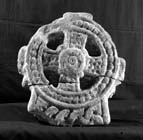
Object type: Cross-head with fragment of -shaft in two joining pieces [1]
Measurements: H. 48 cm (18.75 in); W. 45 cm (17.75 in); D. 14 cm (5.5. in)
Stone type: Pale red (5R 6/2), medium- to coarse-grained (0.3 to 0.6 mm, but mostly medium-grained between 0.4 and 0.5 mm), sub-angular to sub-rounded, clast-supported, quartz sandstone. A few well-rounded quartz pebbles up to 8 mm across and a few scattered angular to sub-rounded black chert? pebbles. Chester Pebble Beds Formation?, Sherwood Sandstone Group, Triassic
Plate numbers in printed volume: Ills. 95-9
Corpus volume reference: Vol 9 p. 66-7
(There may be more views or larger images available for this item. Click on the thumbnail image to view.)
Circle-head with unpierced spandrels and half cylinders set externally on the rim below the lateral arms; cross type B6/12
A (broad): At the centre of the head is a doubly encircled small boss with drilled hole in its crown; the inner ring is formed by minute bosses. There are half-bosses set in the spandrels and the remains of a half-cylinder moulding at the junction of the head and shaft. The arms seem to carry different forms of decoration: four open and linked squares in the upper arm, a pair of linked Stafford knots to the right and left, and a single triquetra in the lower arm. The circle is decorated with a run of small bosses framed by roll-moulding borders. On the shaft below is the upper termination of a median-incised knotwork of unknown form flanked by roll-moulding borders.
B (narrow): On the upper curve of the circle are two Stafford knots whose linking strands cross within a circle; these are set within flanking border mouldings. The framed panel on the end of the arm is decorated with four open and linked squares, whilst the underside of the circle carries the remains of a knotwork termination. On the shaft is a tree- or bush-scroll whose branches, falling to either side of the main stem, carry two plain round leaves.
C (broad): At the centre of the head is a holed boss surrounded by a double ring, the inner ring formed by pellets; bosses fill the spandrels. The arms are decorated with three bosses set in a row within framing borders, whilst the circle carries two-strand plait set within roll-moulding borders. On the shaft below is the upper termination of a median-incised knotwork of unknown type, set within flanking border mouldings.
D (narrow): Framed by a roll-moulding border on one segment of the rim of the circle is a triquetra linked to another damaged knot whilst another segment carries the worn remains of two linked triquetra whose crossing is enclosed by a ring. On the end of the arm is a framed panel containing four open and linked squares. On the edge of the shaft, within flanking border mouldings, is ornament whose form is no longer recognisable.
This elaborately decorated cross-head carries a variety of patterns which are repeated across the circle-head group in Chester, Wirral and north Wales, though not always used in the same manner in the overall composition (see Chapter V, pp. 31–2). Thus circles decorated with bosses recur at Bromborough 3, Chester St John 4, Chester City Walls 1 (Ills. 35, 37, 94, 112–13), Diserth in north Wales (Nash-Williams 1950, no. 185, pl. XXXIII), and Gargrave in Yorkshire (Coatsworth 2008, ills. 289–90) — whilst a simple plait on the circle also seemingly decorates both faces of Chester St John 2 (Ills. 81, 83). The links to Chester St John 4 are particularly strong in their shared use of a range of decorative motifs which are not jointly so exploited in the rest of the group: central rings formed by small bosses; a fret pattern forming open linked squares; cylinders at the junction of head and shaft; and linked Stafford knots with encircled crossing-strands, which otherwise only occur on Chester City Walls 1 (Ills. 94, 112). Rows of triple bosses set in the arms of the cross are not paralleled within the group, though, in a more complex form associated with interlace, runs of three pellets do occur on Yorkshire carvings at Gargrave, Kirby Wharfe, Saxton and Sherburn (Coatsworth 2008, ills. 292, 296–7, 432, 688; Lang 1991, ill. 774); in association with scrollwork they appear on the eighth-century door-jamb at Lastingham in Yorkshire (Lang 1991, ill. 608). As with the triple groups of pellets on Disley Lyme Hall 4 (Ill. 147) they are potentially symbolic of the Trinity. Late Saxon carvings at Barwick in Elmet and Kirkby Grindalythe in Yorkshire offer analogues for the central-stemmed scroll (Coatsworth 2008, ill. 26; Lang 1991, ill. 506) whilst Chester St John 9 has a similar type of leaf form (Ill. 108).
