Select a site alphabetically from the choices shown in the box below. Alternatively, browse sculptural examples using the Forward/Back buttons.
Chapters for this volume, along with copies of original in-text images, are available here.


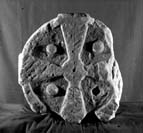
Object type: Part of cross-head [1]
Measurements: H. 46 cm (18 in); W. 46 cm (18 in); D. 19 cm (7.5 in)
Stone type: Pale red (5R 6/2), medium- to coarse-grained (0.3 to 0.6 mm, but mostly medium-grained between 0.4 and 0.5 mm), sub-angular to sub-rounded, clast-supported, quartz sandstone. A few well-rounded quartz pebbles up to 8 mm across and a few scattered angular to sub-rounded black chert? pebbles. Chester Pebble Beds Formation?, Sherwood Sandstone Group, Triassic
Plate numbers in printed volume: Ills. 100-3
Corpus volume reference: Vol 9 p. 67
(There may be more views or larger images available for this item. Click on the thumbnail image to view.)
Plate-head with unpierced spandrels; cross type B6
A (broad): At the centre is a flat disc carrying an incised hole; from this spring the wedge-shaped arms of the cross. The upper arm appears to overlie the moulding which surrounds the head and protrudes beyond that ring; the left arm merely meets it on the same plane. No decoration survives on the ring, but there is an incised line running down the vertical and left arms with parallel incised chevrons running from it. Bosses are set in the middle of the unpierced spandrels; the boss in the lower right has been hollowed out.
B and D (narrow): No decoration survives on the outer edge of the circle.
C (broad): At the centre of the head is a ring-encircled boss with drilled hole. The wedge-shaped arms emerge from the central circle; the upper arm overlies and protrudes beyond the outer ring moulding, whilst the right-hand arm merges with that moulding without any distinction of plane. There is an incised line down the vertical arms.
It is difficult to avoid the conclusion that this is an abandoned or half-finished piece. Compared with Chester St John 1–5 it carries little decoration; the ornament on the arms is merely incised as though a guide for later carving, whilst the most plausible explanation for the hollowed-out boss on face A is that the sculptor cut through his circular guide-line instead of using it as a marker for a raised boss. Like Chester (St John) 7 it does not appear to have been planned as a circle-headed cross, though it can be linked to that group by the fact that its incised chevron ornament is more fully developed on Chester (St John) 3 (Ill. 86). Placing the spandrel bosses in the centre of the unpierced area is also unparalleled within the Cheshire circle-headed group, though there are analogues for this positioning around the Solway, in Wales and on Man (Bailey and Cramp 1988, 144; Nash-Williams 1950, nos. 147, 391, pls. XXXVII, XXXIX; Kermode 1907, no. 53).
